
영문명(English Name) 등록 안내
국제 소통을 위해 회원정보에 영문명을 입력해 주세요.
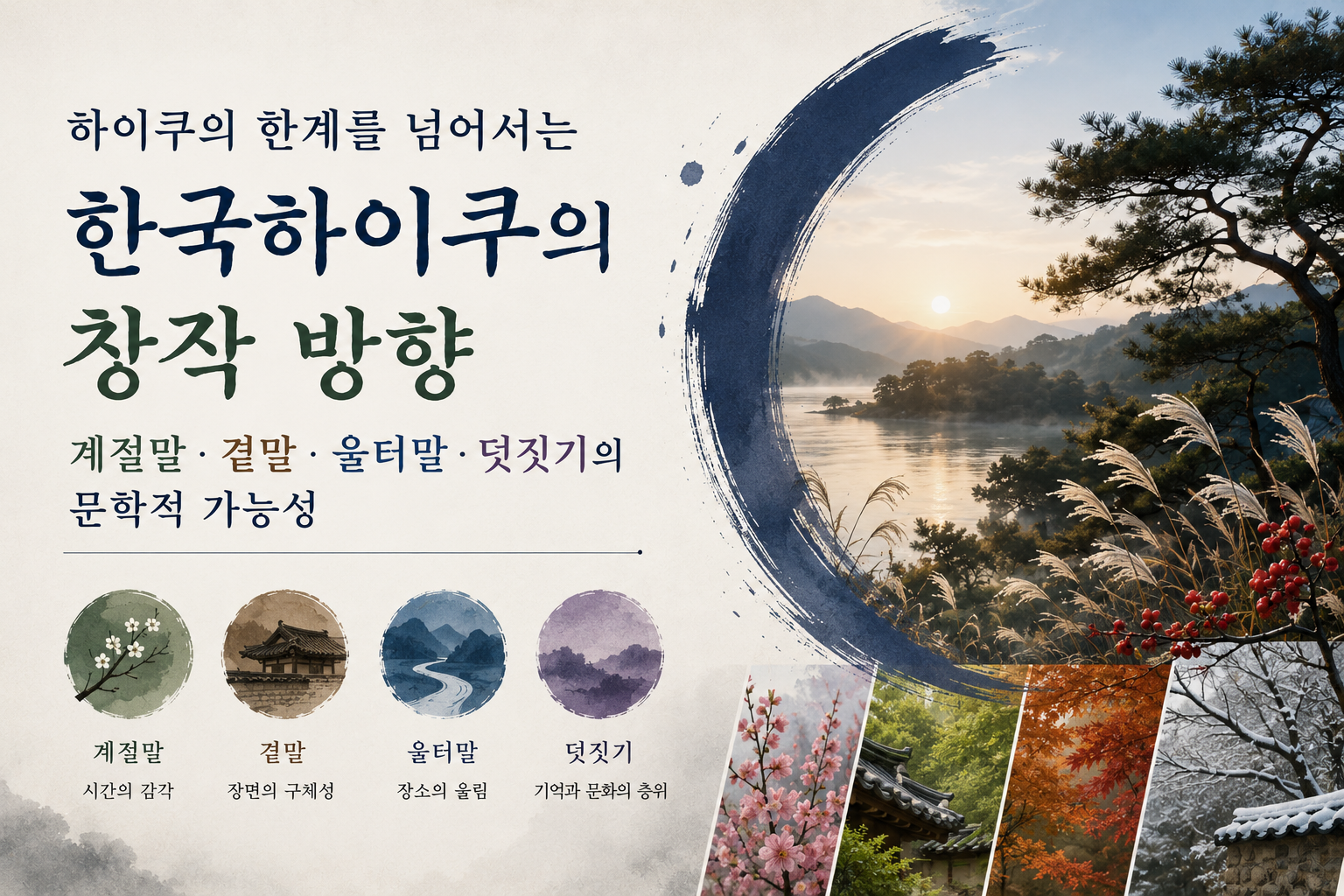
Haiku is one of the shortest yet most expansive poetic forms in the world. Its brief 5-7-5 structure, its seasonal word, and its restrained expression that captures a single moment have made haiku one of the representative genres of Japanese literature. Today, haiku has also established itself as a form of world literature, written in many languages across the globe. Yet precisely because of its brevity and restraint, haiku has always carried one fundamental question: how much depth can be contained within such a short form? Haiku speaks of the season, but whose season is it? It captures a moment, but in what place and within what memory of life does that moment occur? The path that Korea Haiku must open begins with this question. Korea Haiku should not simply follow the form of Japanese haiku. Rather, it should inherit the strengths of haiku—compression and momentariness—while overcoming its limitations through the Korean language and Korean culture. To do so, Korea Haiku needs to establish its own generic system around four creative axes: seasonal words, gyeotmal, ulteomal, and deotjitgi. First, the seasonal word opens the sense of time in Korea Haiku. If the kigo of Japanese haiku was formed on the basis of Japanese seasonal customs and natural sensibility, the seasonal words of Korea Haiku must be newly organized within Korea’s own nature and everyday culture. Spring is opened not only by cherry blossoms and plum blossoms, but also by forsythia, azalea, mugwort, shepherd’s purse, spring rain, and school entrance ceremonies. Summer brings the rainy season, Korean melon, cicadas, sudden showers, and the raised wooden floor of traditional houses. Autumn brings silver grass, persimmons, the Chuseok moon, crickets, and the scent of perilla. Winter brings kimchi-making, roasted sweet potatoes…
Please log in to read the full article.
Log In