
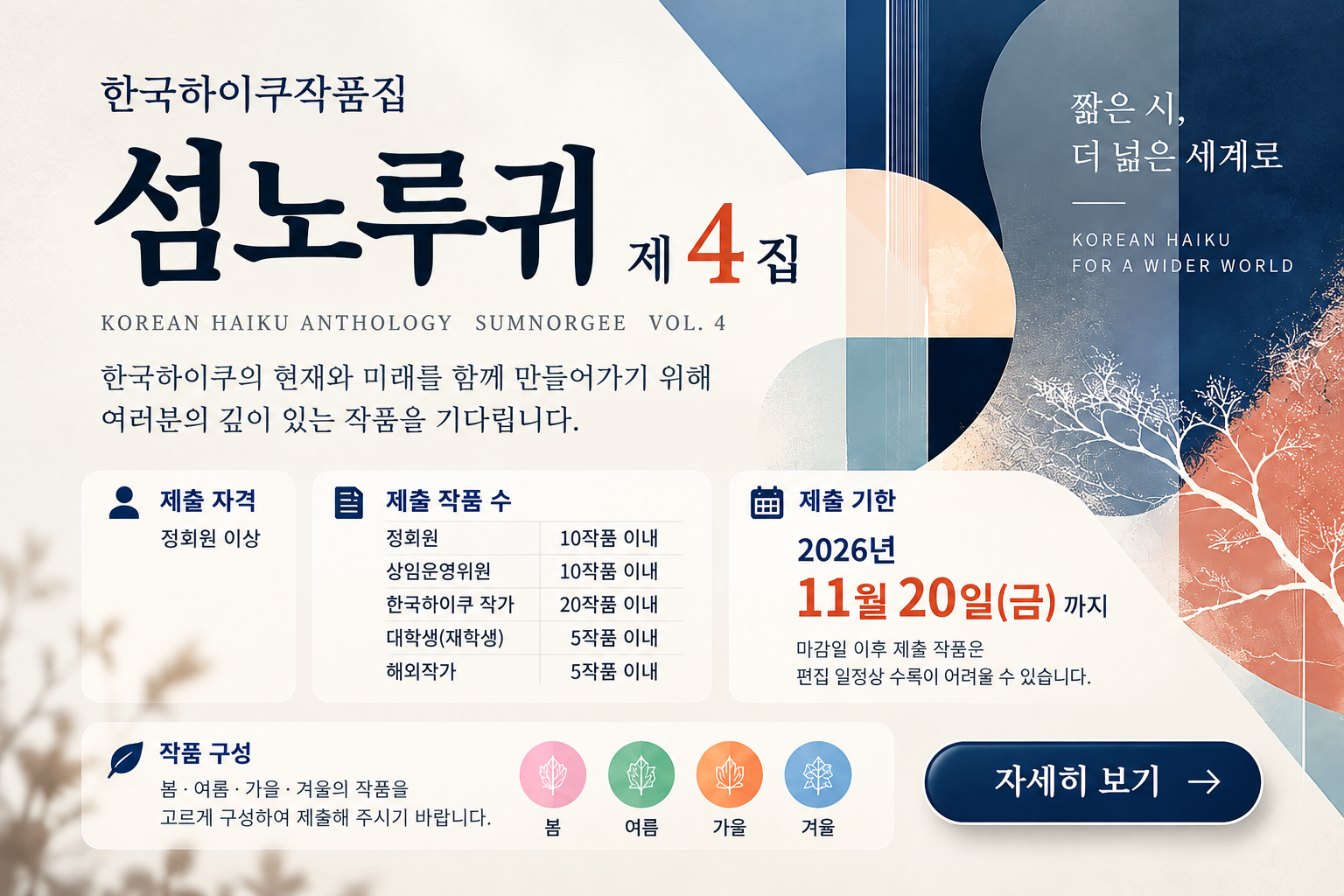
섬노루귀 제4집 작품 모집 안내
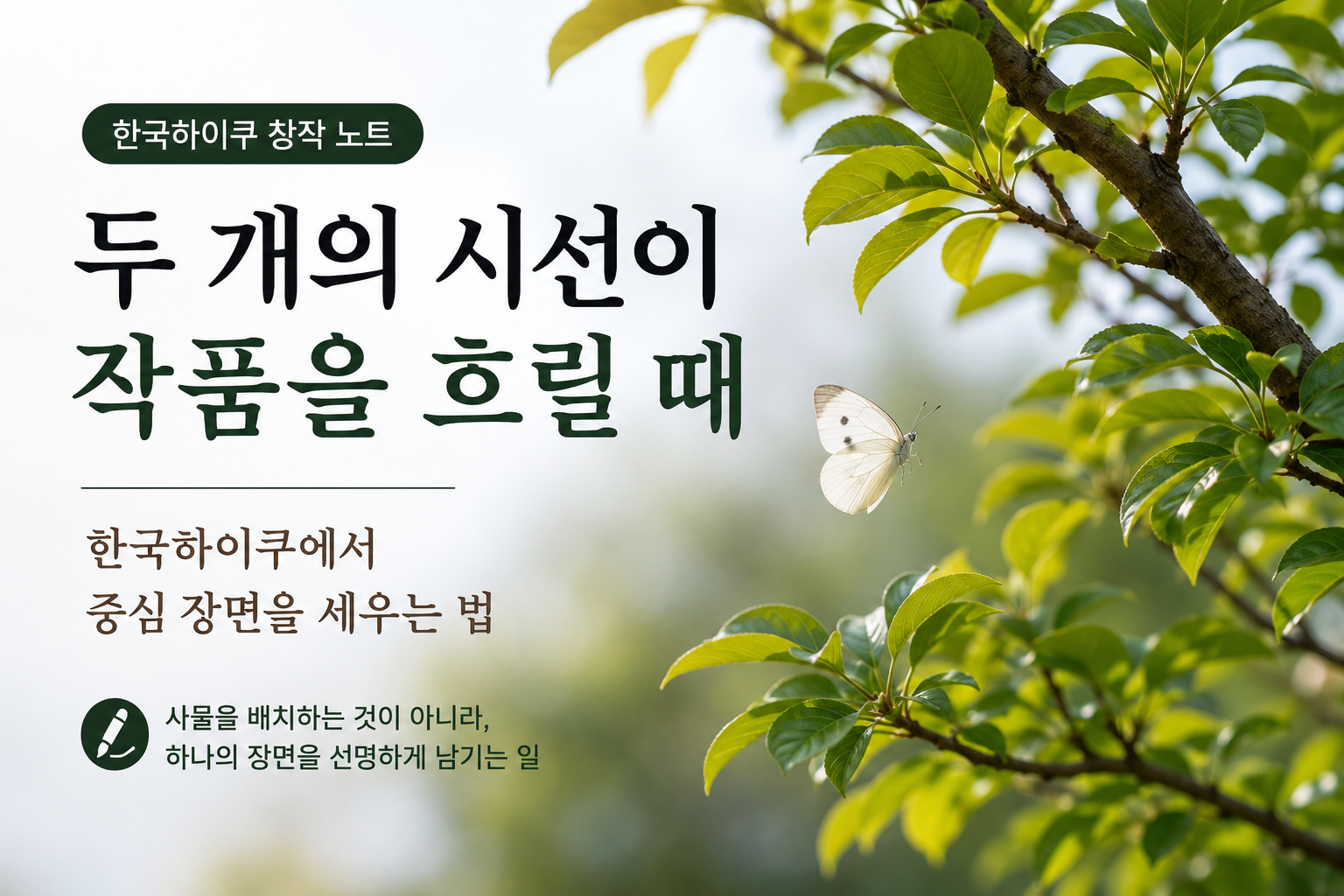
When Two Focal Points Blur a PoemHow to Establish a Central Scene in Korea HaikuKorea Haiku is a literary form that presents a clear scene within a short structure. Since its three lines of 5-7-5 are brief, the placement of objects and the direction of the reader’s gaze become especially important. The clearer the central focus is, the more naturally the reader can enter the scene, and the more deeply the sense of openness and resonance can emerge.It is natural for several objects to appear in a single poem. Real scenes in nature and daily life are not composed of just one object. In a yard, there may be a tree, leaves, wind, and a butterfly. The problem is not that several objects appear, but that they are all placed as if each were the center of the poem. When two or more objects become central at the same time, the reader’s gaze cannot settle in one place and begins to scatter.For example, let us consider the following imaginary poem.Early Summer YardPersimmon Tree And White ButterflySharing A SmileThis poem has a seasonal feeling through “early summer,” and it also presents natural images such as a yard, a persimmon tree, and a white butterfly. However, the second line, “Persimmon Tree And White Butterfly,” places two objects at the center at the same time, causing the reader’s gaze to become divided. The reader may hesitate, wondering whether to …
Please log in to read the full article.
Log In