
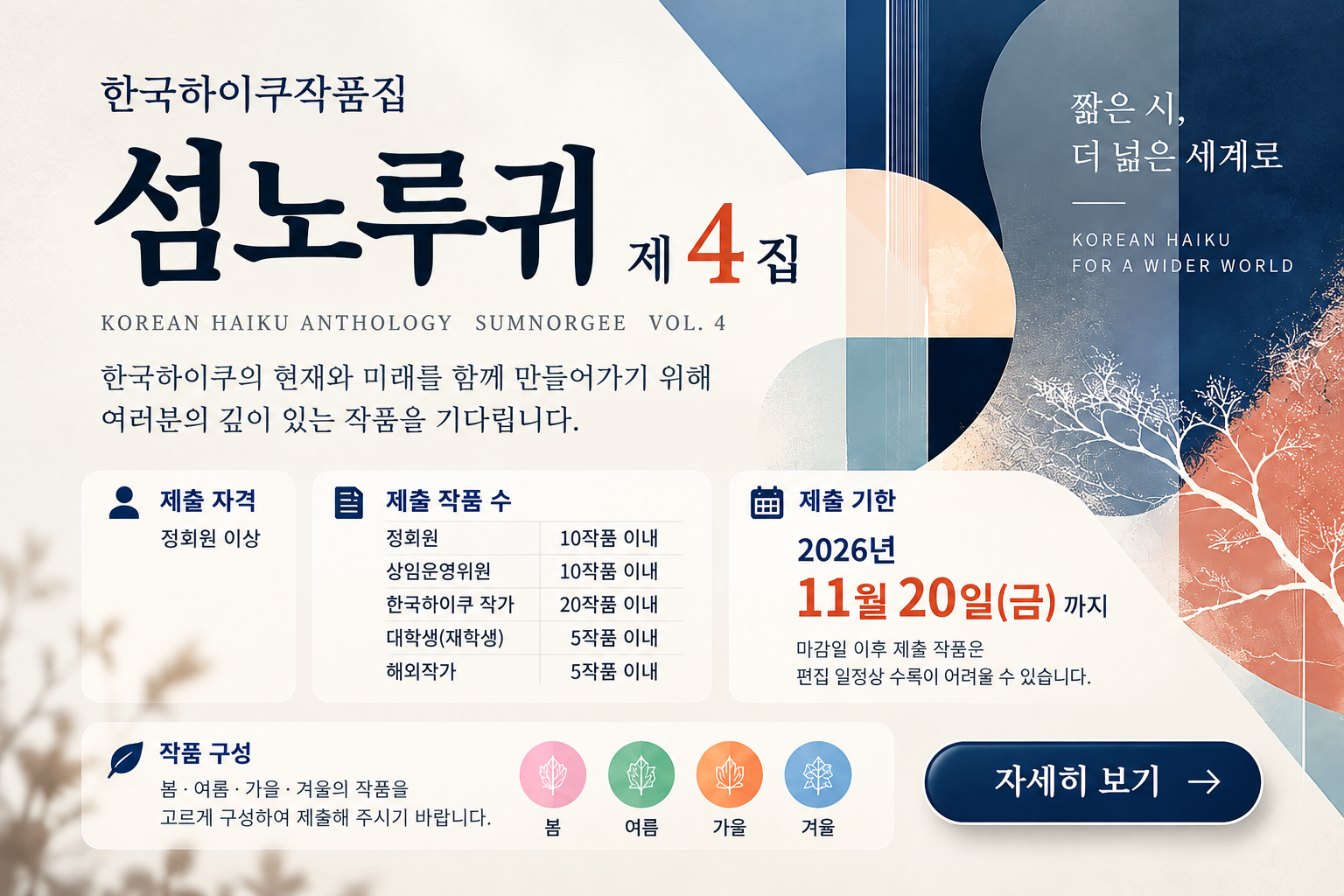
섬노루귀 제4집 작품 모집 안내
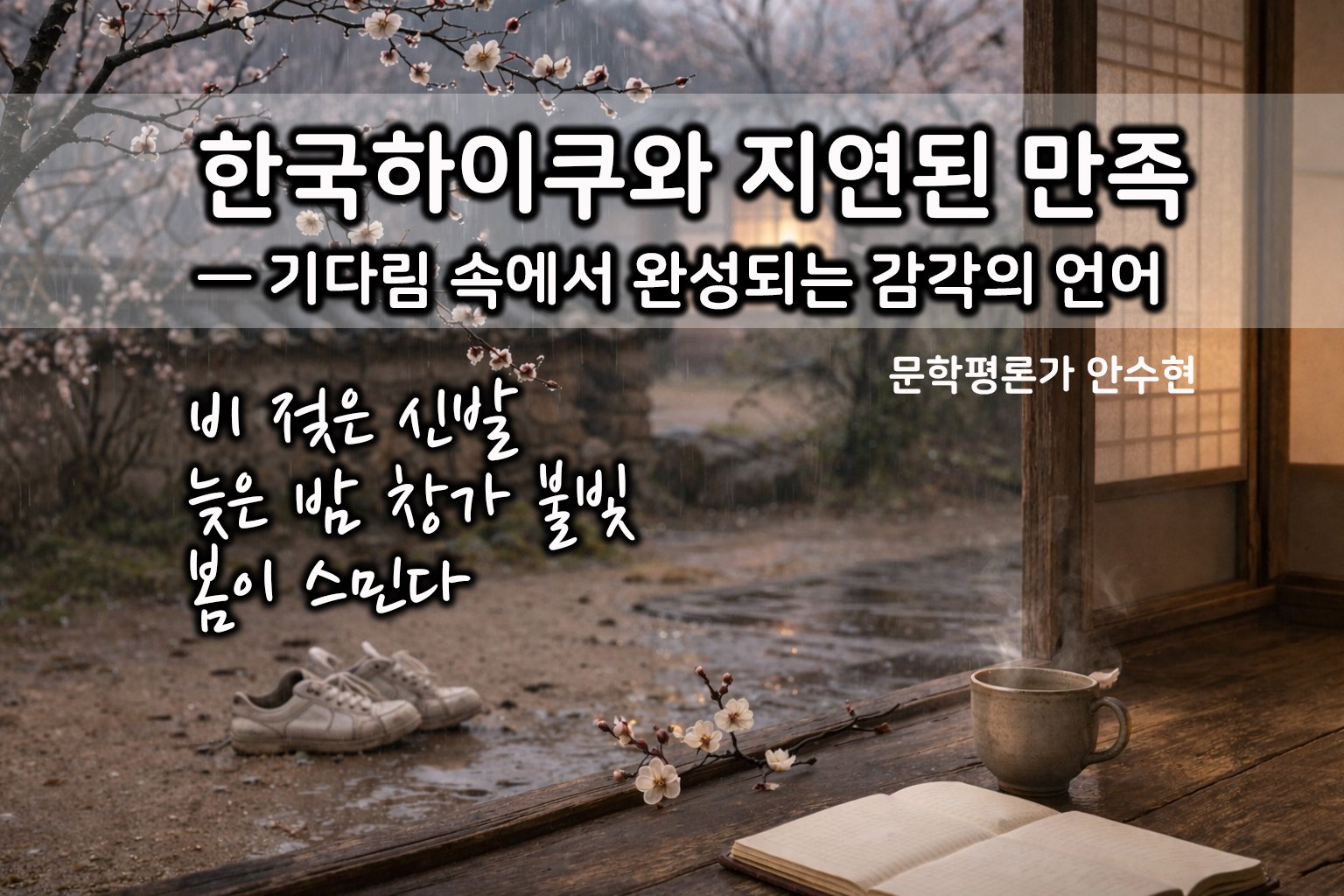
Korea Haiku and Delayed Gratification— The Language of Sensibility Completed Through WaitingLiterary Critic AN SOO HYUNDelayed gratification refers to an attitude of postponing the fulfillment of desire rather than satisfying it immediately. It is not merely a matter of patience, but a conscious choice to entrust the formation of sensation and meaning to the passage of time. The paradox lies in the fact that by not obtaining something immediately, one comes to experience it more deeply. Delayed gratification, therefore, is not simply concerned with results, but functions as a way of expanding the density of the process itself. In this respect, Korea Haiku can be understood as a poetic form that embodies the language of delayed gratification.Haiku does not provide immediate resolution. It does not present a conclusion to emotion, nor does it define meaning in a fixed manner. When readers encounter a haiku, they do not immediately obtain an answer; rather, they are led into a moment of pause. This pause is not a deficiency, but an intentional delay. Haiku presents a single scene and leaves what follows open. Within this empty space, the reader’s sensibility gradually begins to awaken. Instead of immediate understanding, meaning slowly permeates through time. Haiku reaches completion through this gradual process of perception.Korea Haiku reveals this structure of delay even more clearly. The everyday rhythm and familiar vocabulary of the Korean language do not d…
Please log in to read the full article.
Log In