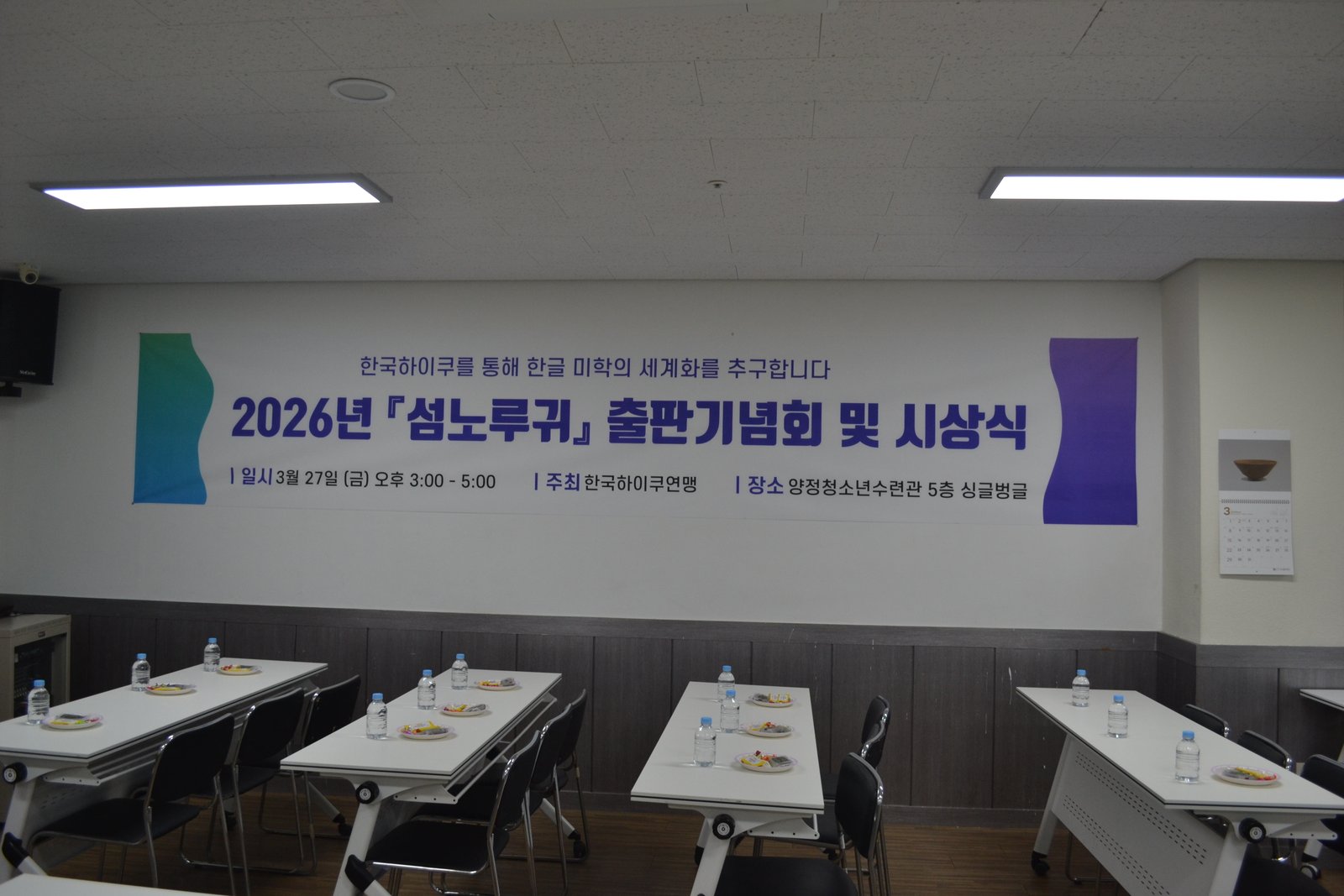
Report on the 3rd Publication Celebration
Publication Report for the 3rd Publication Celebration
Report Date: March 27, 2026
Greetings.
I am Kim Suseong, Chair of the Editorial Committee of the Korea Haiku Federation.
First, I would like to express my sincere gratitude to everyone who has honored this occasion with your presence. I will now report on the publication process of the Korea Haiku anthology Seomnorugwi.
Seomnorugwi, First Issue
Published on December 31, 2023
Title of the anthology: Seomnorugwi
The title refers to a wildflower native to Ulleungdo, an endemic species of Korea. Its symbolic meaning is “trust.”
Background of publication:
From the early days of the Federation, this first issue was published through an ongoing exploration and challenge: whether the literary form of Korea Haiku could express Korea’s own emotions, nature, and sensibility.
Participants:
Regular members of the Korea Haiku Federation, high school division, and university division.
Number of works included:
A total of 202 works.
Composition:
Spring verses, summer verses, autumn verses, winter verses, and non-seasonal verses.
Date and venue of the publication celebration:
January 19, 2024, Sinabro Hall, 5th floor, Yangjeong Youth Training Center.
Attendance:
Approximately 30 participants.
Characteristics and significance:
The first issue laid the foundation for Korea Haiku and was the result of an effort to explore its literary identity. It received positive responses for its beautiful expression of the harmony between nature and human beings. In particular, by including a non-seasonal section, it sought to broaden participation by allowing creative works that did not necessarily include seasonal elements.
Seomnorugwi, Volume 2
Published on January 24, 2025
Background of publication:
Based on the achievements of the first issue, Volume 2 presented the expandability and potential of Korea Haiku through deeper creative work and the participation of younger generations.
Participants:
Regular members and executive committee members of the Korea Haiku Federation, along with university students.
Number of works included:
Approximately 270 works.
Works by regular members and executive committee members:
210 works.
Works by university students:
About 60 works were selected from 280 submitted works.
Date and venue of the publication celebration:
January 24, 2025, Singlebeonggeul Hall, 5th floor, Yangjeong Youth Training Center.
Attendance:
Approximately 35 participants.
Characteristics and significance:
Volume 2 expanded both the diversity and depth of creative practice. Through the emergence of new writers and the participation of younger generations, it presented a bright future for Korea Haiku. Based on a seasonal structure, the anthology harmoniously expressed nature and emotion, offering readers a deeper sense of resonance. In addition, through foreign-language translation, international exchange, and literary collaboration with free verse and modern sijo, it suggested a model for inter-literary exchange and confirmed the broader possibilities of Korea Haiku.
Seomnorugwi, Volume 3
Published on March 27, 2026
Background of publication:
Building on the achievements of the first issue and Volume 2, Volume 3 was published in order to further broaden the creative foundation of Korea Haiku and to develop into a more substantial anthology embracing both the general and university divisions.
Participants:
General division and university division of the Korea Haiku Federation.
Number of works included:
A total of 280 works.
Works by the general division:
181 works.
Works by the university division:
From a total of 624 submitted works—258 from Pusan National University and 366 from Busan University of Foreign Studies—97 works were selected.
Opening and closing verses:
2 works.
Date and venue of the publication celebration:
March 27, 2026, Singlebeonggeul Hall, 5th floor, Yangjeong Youth Training Center.
Characteristics and significance:
Volume 3 demonstrates that the creative foundation of Korea Haiku is expanding further through a composition in which the general and university divisions come together. While grounded in traditional seasonal sensibility, the works naturally incorporate the everyday landscapes and emotions of younger generations, such as commuting paths, bus stops, classrooms, subway trains, bungeoppang, tangerines, and kimchi-making. In doing so, the anthology more clearly reveals the modern expandability of Korea Haiku. It also organically connects the creative flow between generations, confirming that Korea Haiku can newly shape nature and human emotion through the language and lived sensibility of the present day.
This concludes my report on the publication process from the first issue of Seomnorugwi to Volume 3.
With each passing year, Seomnorugwi continues to strengthen the literary identity of Korea Haiku and establish itself as a creative space that connects one generation with the next. The Korea Haiku Federation will continue its steady efforts for the development of Korea Haiku, a literary form that embraces Korea’s emotions, nature, and contemporary life.
Thank you.