
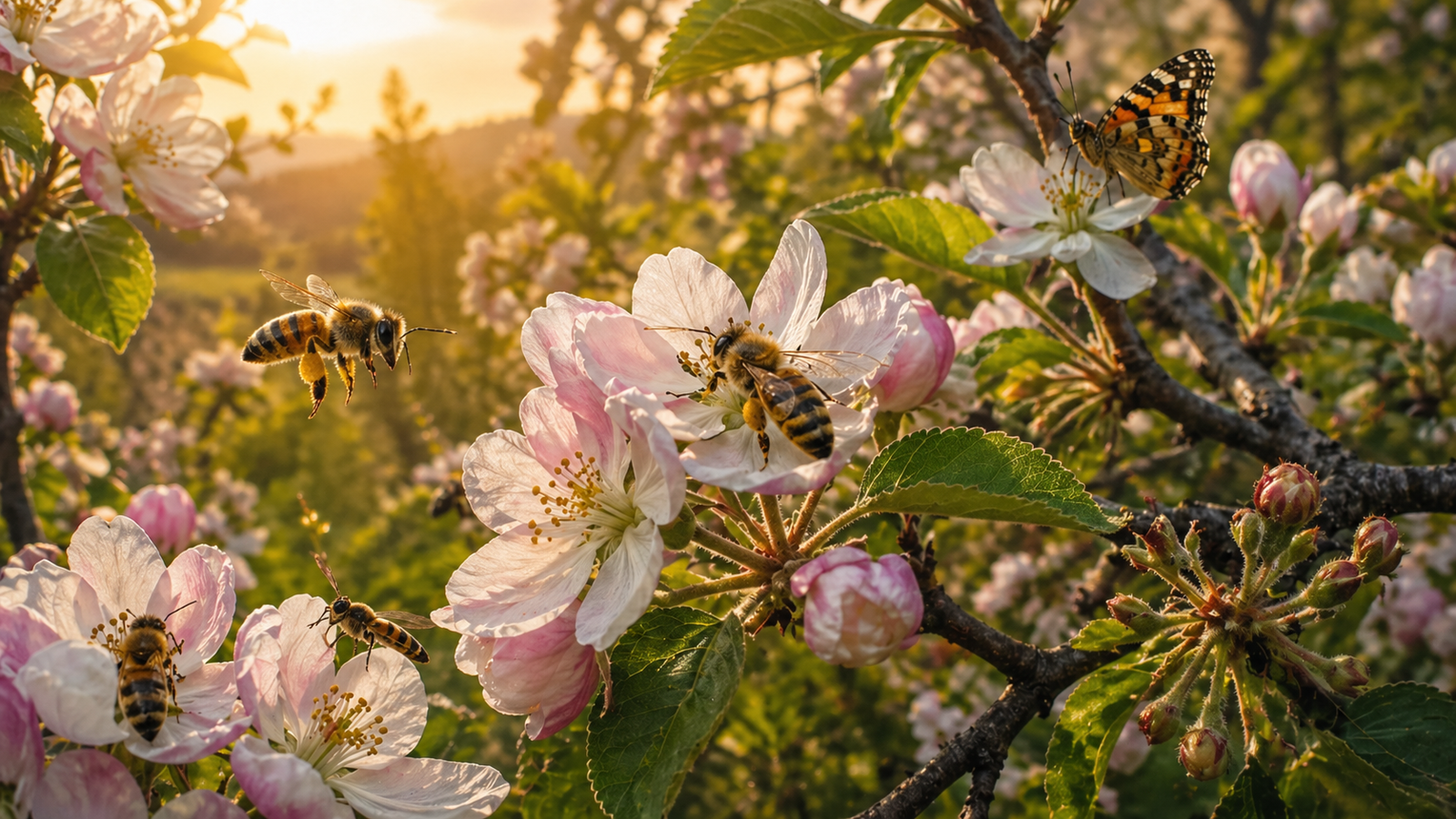
Dear Bees, Thank You
When spring flowers bloom, people first notice their colors. They look at pink, white, pale yellow, and fresh green petals and say that the season has arrived. Yet the first beings to work near the flowers are not human beings. Small bees, butterflies, hoverflies, and beetles move from flower to flower, making invisible paths. Along those paths, pollen is carried, and the time of fruit begins quietly.
When we look at fruit, we usually think of the tree’s labor. We think of roots, stems, leaves, sunlight, rain, and soil. Yet we often forget that there was also a small flutter of wings in between. As one bee enters a flower, covers its body with pollen, and flies again to another blossom, apple trees, plum trees, and pumpkin flowers open the door to the next life. The FAO explains that pollinators such as bees, butterflies, birds, and bats play an important role in food production, nutrition, and biodiversity by transferring pollen.
Come to think of it, fruit is not produced by the tree alone. Even if flowers bloom, the path toward fruit is cut off when no visitor comes. Small insects approach the flowers, and the flowers welcome them with nectar and fragrance. This brief meeting creates seeds, and seeds carry the season forward. The United States Department of Agriculture explains that about three-fourths of the world’s flowering plants and about 35 percent of the world’s food crops depend on animal pollinators. This means that a considerable part of the food we eat is connected to the help of these small and diligent lives.
That is why our feeling toward bees should begin with gratitude rather than fear. Bees are workers of the flower garden and, at the same time, carriers of the season. The pollen on their tiny legs may look like dust, but it is a promise of the next fruit. Their buzzing is not noise; it is the sound of work. Behind the apples, plums, pumpkins, melons, cucumbers, and even the seeds of wildflowers we eat and see, there lies the day’s labor of insects that are not easily noticed.
Of course, bees are not everything. Hoverflies, butterflies, moths, beetles, and flies also carry pollen. The United States Forest Service explains that many different living creatures, including bees, ants, bats, birds, butterflies, moths, flies, beetles, and wasps, act as pollinators. Nature is not the solo performance of one species. It is closer to a chorus sung together by countless small beings.
The words “Dear bees, I love you” are not merely a cute expression. They are a form of courtesy that human beings must learn before nature. We should not be grateful only to the tree that has bloomed. We should also be grateful to the small wings that connect flower to flower. When we bite into a piece of fruit, its sweetness contains not only sunlight and rain, but also the movements of insects that have made their way through the flowers.
Haiku is a literature that looks long at one small scene rather than offering a large explanation. When writing of bees, it is enough to look not at a grand ecological discourse, but at the legs of a bee resting on a single flower, its pollen-covered belly, and one flower stem trembling for a moment. In that instant, we come to know that life continues not only through what is large and splendid, but also through very small and faithful movements.
Now, when I meet bees in a flower garden, I want to look at them a little differently. Rather than waving my hand thoughtlessly, I want to step back and watch their labor. Wherever those small wingbeats pass, flowers dream of fruit, trees prepare seeds, and summer slowly ripens.
Dear bees, thank you.
After you pass by,
the world becomes a little sweeter.
Grateful bees
Pollen on the tips of your feet
The time of fruit