
Cultural Critic Kim Soo-sung
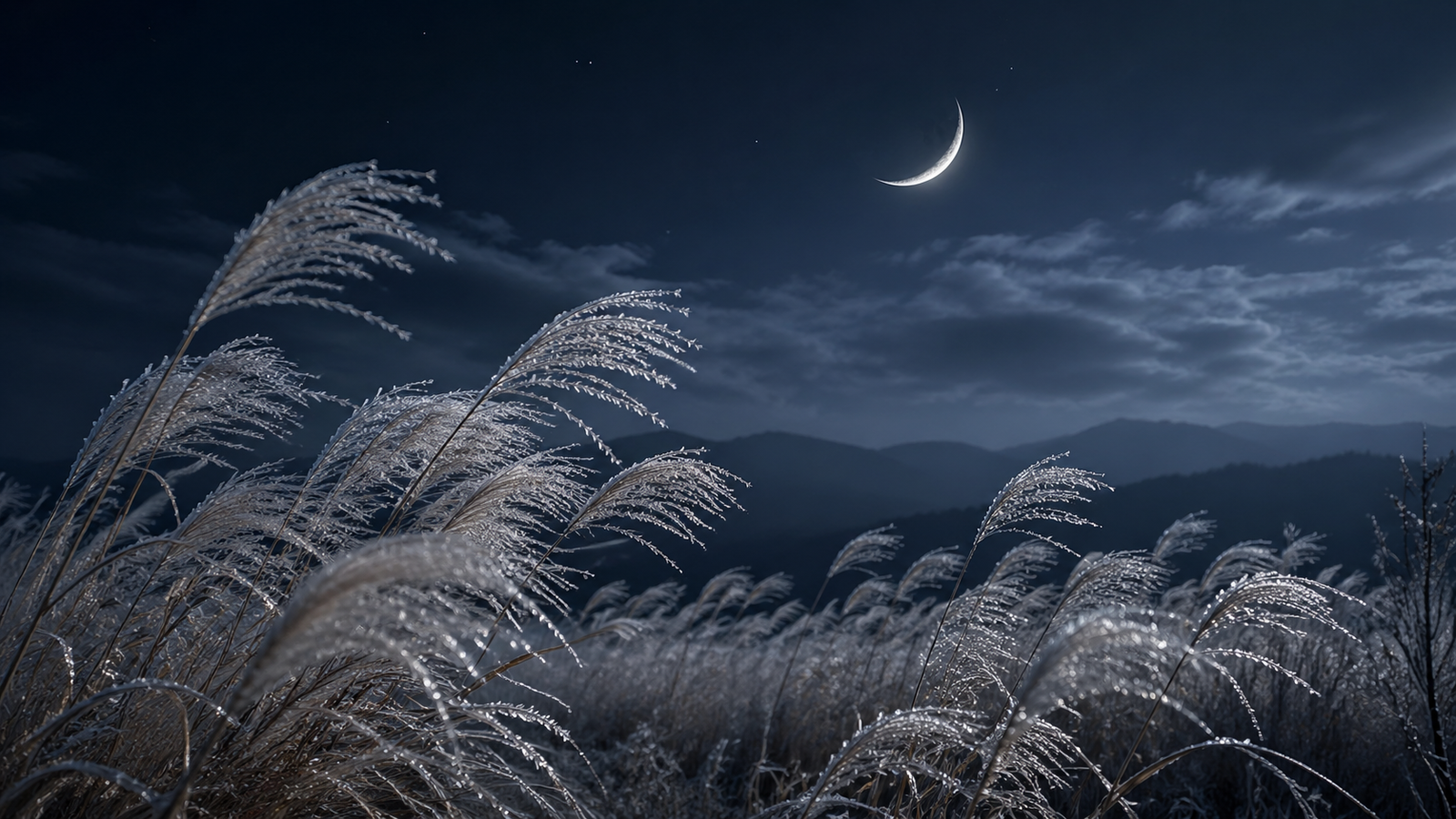
Today, through a work by Oh Gi-seok, I would like to pause for a moment and consider how Korea Haiku, within its brief form, can contain a deep sense of time and existence. In this work in particular, the three images of “frost,” “silver grass,” and “the dark moon” interlock with one another, evoking at once the seasonal threshold from late autumn into winter and the twilight of human life.
Frost at my ear
I turn—and silver grassThe dark moon alone— Oh Gi-seok
In Korea Haiku, the seasonal word is an important device that opens the time and emotion of a work. In the poem above, too, the seasonal words do not merely serve as background markers. “Frost,” “silver grass,” and “the dark moon” are each natural phenomena, yet at the same time they function as symbolic scenes that reflect the sensations of human existence.
The first line, “Frost at my ear,” is especially striking. Frost is usually understood as a natural phenomenon that forms overnight when the temperature drops. Here, however, by being joined with the bodily part “ear,” it moves beyond a simple seasonal description. Frost settling at the ear is the sensation of cold air, but it also calls to mind white hair and old age. The ear is the organ that hears sound, while frost is a cold trace destined to disappear. Therefore, “Frost at my ear” may be read as an expression that contains the time of aging, the sounds of a life already lived, and the chill of life that suddenly approaches at a certain moment.
The second line, “I turn—and silver grass,” shows a shift of gaze. The speaker hears or senses something and then turns around. At that moment, what appears before the eyes is silver grass. Silver grass is a plant that represents the height of autumn, and because of the way it sways in the wind, it often evokes loneliness and the passage of time. If the frost in the opening line is a cold and subtle sensation, silver grass is an image that calls forth a wide field and the movement of wind. At this point, the work moves from auditory sensation to visual landscape. The coolness that began at the ear expands, at the moment of turning, into the landscape of silver grass.
The final line, “The dark moon alone,” leads the entire work toward solitude and reflection. The dark moon is a moon in the process of disappearing. It is not full like the full moon, nor does it carry the fresh energy of beginning like the new crescent. The dark moon is situated at the moment when its light has almost vanished. Yet it is not completely absent. A faint light remaining in darkness, a trace of existence still present while moving toward disappearance—this is the dark moon. Thus “The dark moon alone” goes beyond a simple description of the night sky and symbolizes the moment when human beings must ultimately face their own existence alone.
Through these three seasonal devices, the work reveals a sense of impermanence. In Buddhism, impermanence refers to the principle that nothing remains fixed, but everything constantly changes. Frost disappears when the sun rises, silver grass sways in the wind as it passes through the dry season, and the dark moon waits in the darkness for the time when it will wax again. All three images contain disappearance, but at the same time they also contain the possibility of return and renewal. Therefore, the emotion of this work does not remain merely in the sadness of extinction. It quietly shows that disappearance and beginning again exist within a single flow.
The work also contains a deep sense of inner solitude. The phrase “The dark moon alone” is both a lonely landscape in nature and a mirror reflecting the human interior. Human beings live in relationships within society, but at some point they must turn back and face their own time alone. This solitude is not necessarily tragic. Rather, it is a place of reflection that allows one to look honestly at one’s own existence. Just as Nietzsche emphasized that human beings should not depend solely on external values but must create the meaning of their own lives, the speaker in this work may also be seen as quietly contemplating his own existence before the images of nature.
In terms of the relationship between nature and human beings, this work also touches upon an East Asian mode of thought. Silver grass and the dark moon are not merely background elements; they are presences that reflect the speaker’s mind. Human beings come to understand their own condition by looking at nature, and within the flow of nature they rediscover the place of their own lives. This is also connected to the kind of free union with nature suggested in Zhuangzi’s thought: an attitude that accepts one’s place within the flow of the world rather than trying forcibly to accomplish something. Oh Gi-seok’s haiku does not use nature as decoration for human emotion. Nature reflects the human interior while also guiding human beings to understand their lives within a broader flow.
Therefore, this work is not simply a haiku that sings of a winter night scene. The three images of “frost,” “silver grass,” and “the dark moon” evoke, in layered form, old age, time, solitude, impermanence, and reflection. In particular, the power of this work lies in its refusal to explain. Without directly using words such as aging, loneliness, or transience, it allows the reader to arrive naturally at those emotions by following the three scenes. This is the power of compression that Korea Haiku possesses.
Ultimately, Oh Gi-seok’s “Frost at my ear” is a work that looks at things that are passing away. Yet that disappearance is not presented as despair, but as an inevitable process to be accepted within the flow of life. Frost disappears, silver grass sways, and the dark moon remains alone in the darkness, but all these images return again into the cycle of the seasons. The solitude in this work is not tragic isolation, but a time in which existence looks deeply into itself.
Within three brief lines, nature and life, season and philosophy, sensation and reflection are placed together. In this respect, the work clearly shows that Korea Haiku is not merely a short poem, but a literary form that compresses the deep time of life.
Reference Notes
The Buddhist concept of impermanence is based on the idea that all beings do not remain as fixed substances, but exist within processes of change and disappearance. It is a central concept repeatedly found in early Buddhist scriptures, including the Saṃyukta Āgama.
Friedrich Nietzsche’s concept of the Übermensch is developed in Thus Spoke Zarathustra and is connected to the idea that human beings should create the meaning of their own lives rather than depending solely on external or absolute values.
The idea of Xiaoyao You appears in the “Free and Easy Wandering” chapter of the Zhuangzi. It presents an attitude of freely existing within the flow of nature, free from artificial attachment.