
Korea haiku is often described as a short form of poetry, but its essence does not lie merely in brevity. Rather, it is a literary art that condenses a moment of discovery into a few carefully chosen words. For this reason, the true starting point of Korea haiku is not eloquent language or elaborate rhetoric, but observation.
We encounter countless sights every day, yet most of the time we only glance at them. We believe we have seen them, but in reality we have not truly looked. A flower blooming by the roadside may simply register as “a flower.” A haiku poet, however, pauses for a moment longer. The poet notices the texture of the petals, the shape of the stamen, the direction of the wind, and perhaps a tiny insect resting upon the bloom.
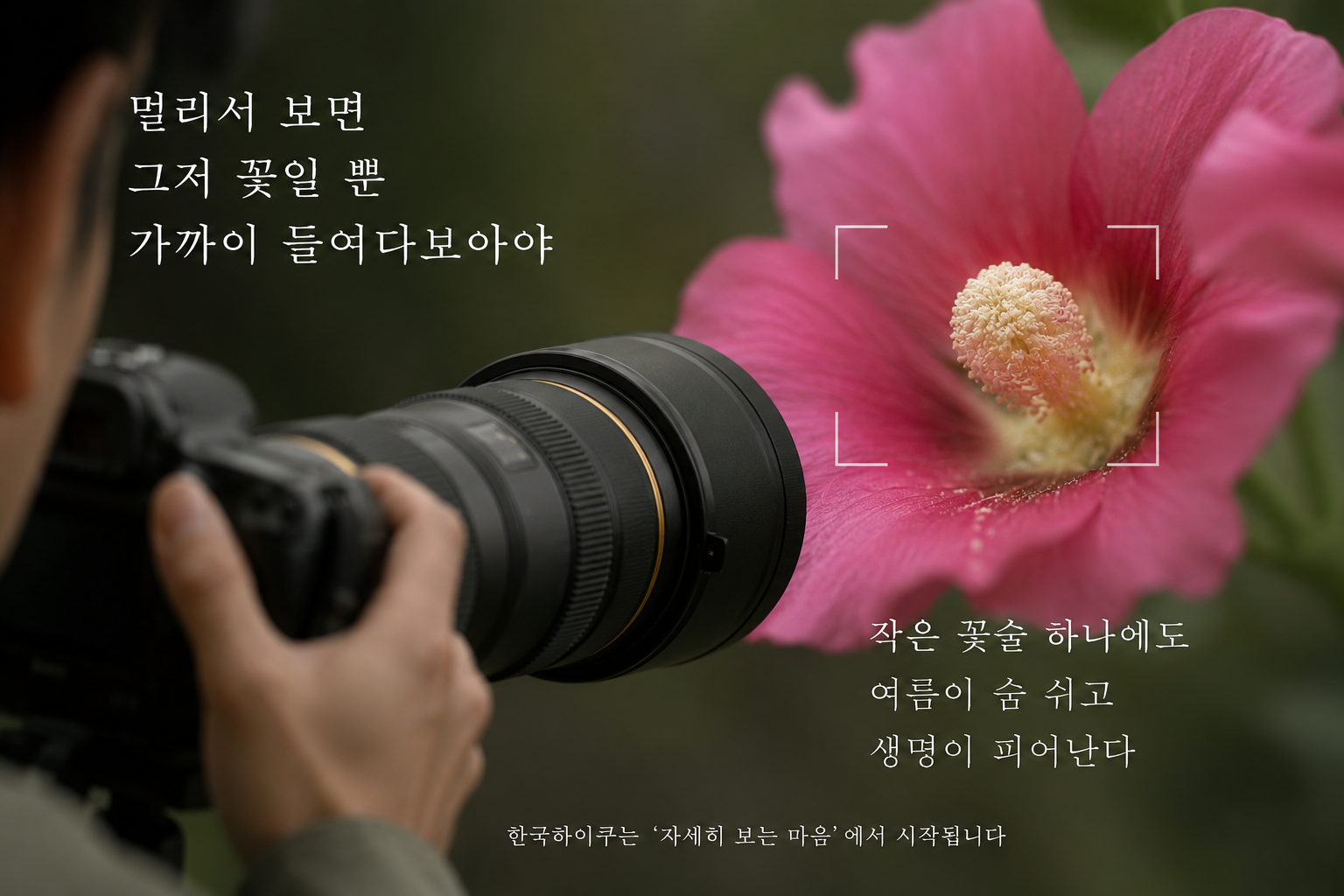
The image of a photographer focusing a telephoto lens on a flower’s stamen beautifully illustrates this spirit of haiku. From a distance, it is merely a flower. Through the lens, however, an entirely different world emerges. Pollen grains resting on the stamen, delicate veins running through the petals, and dew drops reflecting the morning light all become objects of wonder. Haiku begins with such discoveries.
The great haiku master Matsuo Bashō once advised his disciples, “If you wish to know the pine, learn from the pine itself.” His words remind us not to impose our own interpretations upon things, but first to observe them deeply and honestly. Haiku is not a literature of explanation; it is a literature of attentive seeing.
Korea haiku inherits this tradition while grounding itself in the landscapes and daily life of Korea. The shepherd’s purse of spring, the hollyhock of summer, the persimmon tree of autumn, and the drying soybean blocks of winter are all familiar scenes. Yet while one person may pass them by without notice, another may discover within them the subtle movement of the seasons and the pulse of life itself. That discovery becomes poetry.
One of the most common mistakes among beginning writers is to interpret before observing. They see a flower and immediately write “beautiful.” They see rain and call it “lonely.” They see fallen leaves and describe them as “sad.” Such expressions reveal the poet’s feelings, but they often leave little room for the reader’s imagination. Haiku, by contrast, presents a scene and allows the reader to arrive at meaning independently.
Observation is therefore more than an act of seeing. It involves listening to the sounds of nature, sensing the direction of the wind, noticing changes in light, and feeling the passage of time. In this sense, haiku is not only a way of writing poetry but also a way of learning to look more deeply at life.
The aim of Korea haiku is not grand philosophy or ornate language. It is the discovery of a season, a moment, and a living presence within the smallest details of the world. To look more carefully, more patiently, and more deeply—this is the spirit of observation that lies at the heart of Korea haiku.
Ultimately, great haiku does not begin with extraordinary imagination. It begins with an ordinary object seen in an extraordinary way. The ability to look not merely at a flower, but at a single stamen within that flower, is where Korea haiku truly begins.