

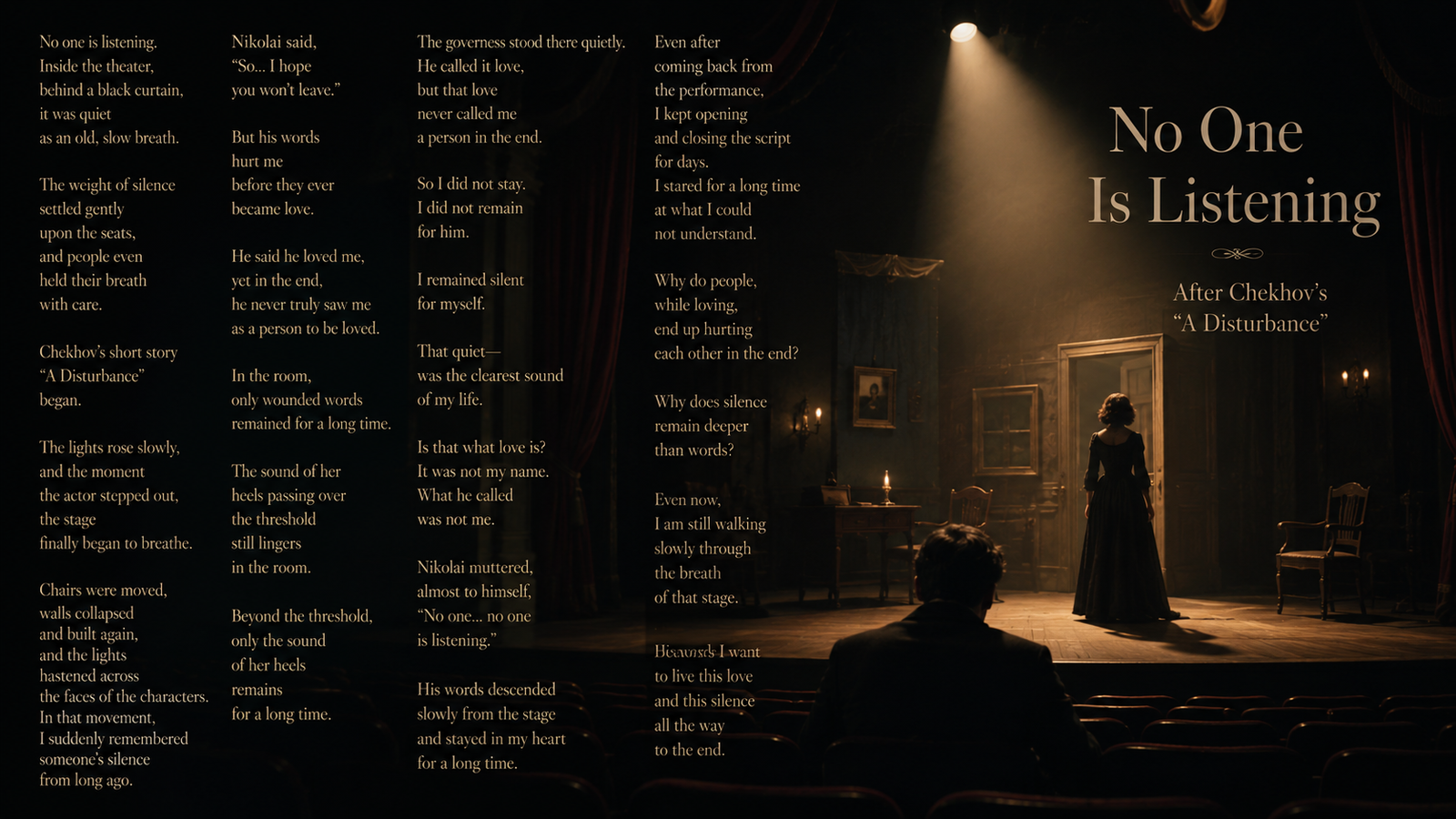
Inside the theater,
beneath the drawn black curtain,
it was quiet
like an old breath.
The weight of silence
slowly settled over the seats,
and people inhaled
even their breaths with care.
Chekhov’s short story, A Disturbance, began.
The stage lights slowly rose,
and the moment the actor stepped forward,
the stage itself
seemed to begin breathing.
Chairs were moved,
walls collapsed and were built again,
and the lights hurried restlessly
across the actors’ faces.
Within that movement,
I suddenly remembered
someone’s silence from long ago.
Nikolai said,
“So…
I hope you will not leave.”
But his words
wounded before they ever became love.
He said he loved her,
yet in the end
he could not look upon the one he loved
as a human being.
Inside the room,
only wounded words
lingered for a long time.
As she crossed the threshold,
the sound of her heels
seemed still to remain inside the room.
Beyond the doorway,
only the sound of heels
lingered behind.
The governess stood quietly.
He called it love,
but that love
could never call me
a person in the end.
So I did not remain.
I was not silent for him.
I remained silent for myself.
That silence
was the clearest sound
of my life.
Love, you say—
That was never my name.
What he called
was not truly me.
At last Nikolai murmured,
almost like a soliloquy:
“No one…
No one is listening.”
Those words slowly descended
beneath the stage
and remained in my heart
for a long time.
Even after returning from the performance,
for days
I kept opening and closing
the play script.
I stared for a long time
at what I could not understand.
Why do people,
even while loving one another,
end up hurting each other in the end?
Why does silence
remain deeper than words?
Even now,
I am still slowly walking
through the breath of that stage.
Because I want to live
through this love
and this silence
to the very end.