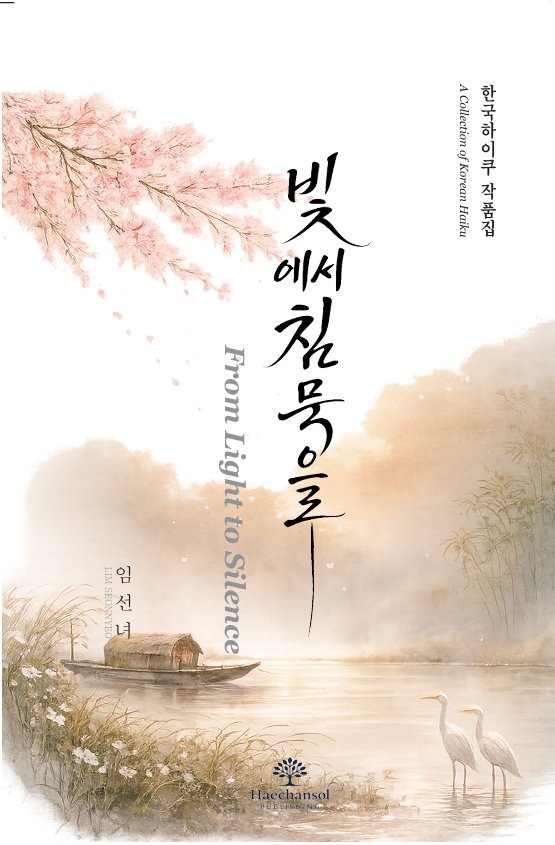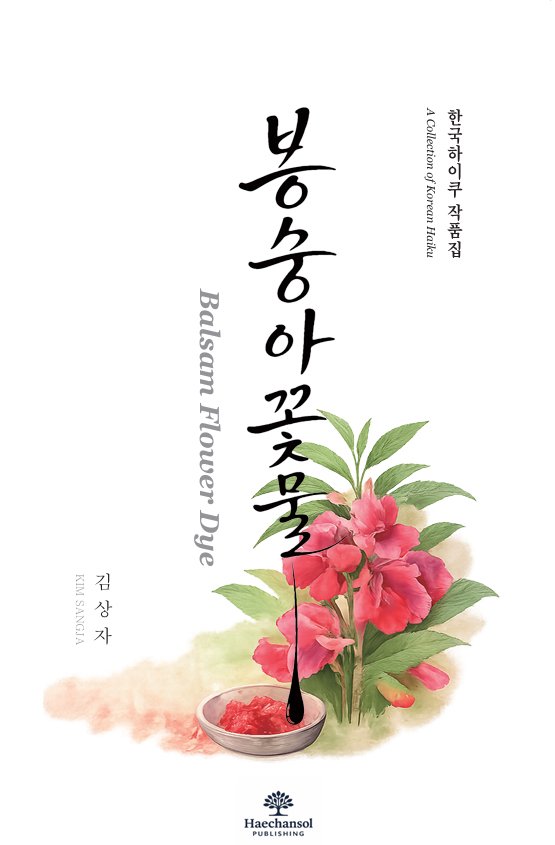
Kim Sang-ja’s Balsam Flower Dye and Lim Seon-nyeo’s From Light to Silence scheduled for publication on Friday, February 27, 2026
HCS Books will simultaneously publish Balsam Flower Dye, the first individual anthology by Korea Haiku writer Kim Sang-ja, and From Light to Silence, an individual anthology by Lim Seon-nyeo, on Friday, February 27, 2026. The two anthologies are expected to stand as a pair of meaningful achievements, each revealing the present of Korea Haiku—“leaving a long resonance through brief language”—through its own distinctive texture of sensibility.
In the recent creative field of Korea Haiku, there has been a noticeable increase in the publication of individual anthologies that go beyond literary coterie magazines and joint collections, gathering the sensibility and world of a single writer into the rhythm of one book.
This trend reflects the way short-form poetry no longer remains merely a “momentary impression,” but instead gathers into the unique aesthetics of each writer through recurring images, tone, and the use of silence.
At the same time, as community-based activities such as creative writing, lectures, and archiving have expanded through organizations including the Korea Haiku Federation (KHF), a stronger foundation has also been established for each writer’s individual “voice” to emerge more clearly.
The title Balsam Flower Dye immediately evokes the sensory reservoir of Korea’s everyday folk culture. The custom of dyeing fingernails with balsam flowers involved crushing the flowers and leaves to stain the nails, and it has long been remembered both as a simple form of adornment for girls and women and as a practice associated with the red color’s meaning of warding off misfortune.
This anthology borrows the sensibility of that “time of being dyed” and suggests a way in which each haiku slowly spreads and remains in the heart. Rather than fleeting images that pass quickly, the poems linger like a light that remains on the fingertips and cannot easily be erased. Memory, longing, and the tactile feeling of the seasons seep through the brief spaces between the lines into the reader’s present.
It is also said that dyeing fingernails with balsam flowers was “a simple form of adornment for girls and women in earlier times when cosmetics were not widely available.”
Lim Seon-nyeo’s From Light to Silence follows, with precision, the sensory trajectory suggested by its title: a movement from “illumination” or “revelation” toward “leaving things still,” that is, toward space and silence.
The anthology captures the subtle tremors of everyday life, yet its central method is not explanation. Rather, it leaves sensation behind through restraint and blank space.
The emotional tone that runs through this collection may be described as “what becomes clearer because it is not overexplained.” The afterimage left where light has disappeared, the inner sound that becomes audible after a sentence stops—these are the silences after which the reader is invited to complete the poem. A phrase such as “The fewer the words, / the clearer the heart becomes” would be especially fitting as a book-band line.
The two anthologies open different doors.
If Balsam Flower Dye calls forth the texture of Korea’s time through the tactile memory of traditional folk custom, From Light to Silence presents the depth of a modern minimalist sensibility through silence and restraint.
Together, the two books ultimately tell us this: the “brevity” of Korea Haiku is not reduction. Rather, it is a technique of expansion, one that condenses sensation and thought so that they may resonate more deeply.