
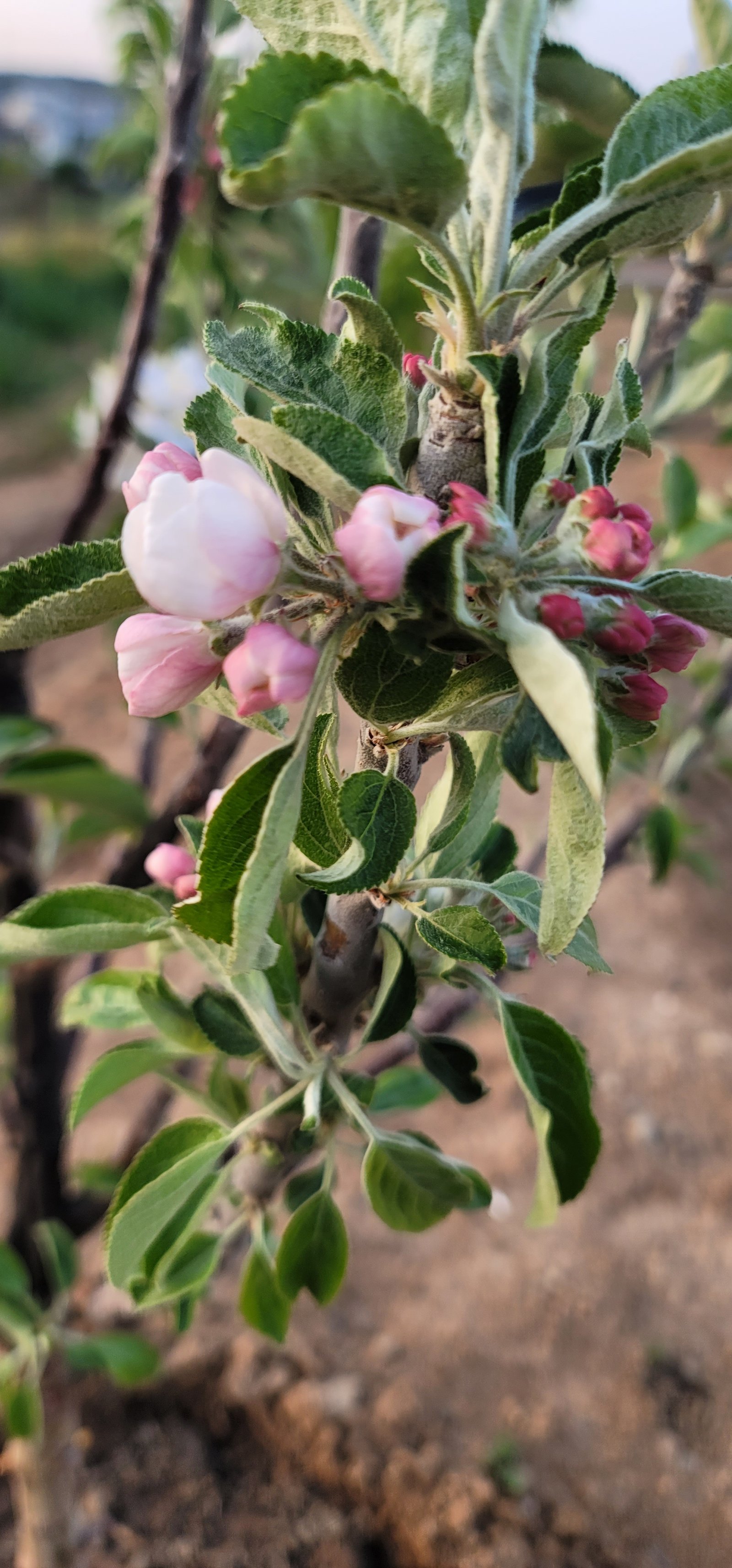
Apple blossoms bloom at the height of spring, yet they already contain a double sense of time that foretells fruiting. If cherry blossoms may be called an aesthetics of scattering, apple blossoms may be called a narrative of forming. As flowers that are also signs of future fruit, apple blossoms are among the subjects that most clearly reveal haiku’s power to capture a moment and compress time.
In the Japanese haikai tradition, “flowers” have generally centered on sakura. This is also an established mode of appreciation that took root after the Edo period. In haiku after Matsuo Bashō, flowers often came to mean cherry blossoms, a tendency repeatedly confirmed in travel writings such as Oku no Hosomichi. Apple blossoms, however, stand somewhat apart from such central seasonal words. Precisely for this reason, they become an important subject through which modern haiku, and especially Korea Haiku, can newly expand its sensory field.
Apple blossoms usually bloom from late April to early May, on the boundary between full spring and early summer. Their petals are white with a pale pink hue, and their texture is firmer and thicker than that of cherry blossoms. This subtle difference in materiality creates a different texture of sensation. If cherry blossoms are a “visual event” that scatters in the wind, apple blossoms are closer to an “olfactory and tactile event” that can only be felt when one approaches them closely. Their fragrance is gentle, and the blossoms do not fall easily. In this sense, apple blossoms contain an aesthetics of staying.
Within Korean agricultural culture, apple blossoms are connected to an even more concrete sense of lived time. The blooming of the flowers marks the beginning of preparation for fruiting, and for farmers it is an important moment that foreshadows the year’s harvest. Thus the gaze directed at apple blossoms contains not only simple appreciation, but also labor, waiting, and a sense of the future. When these layers are compressed into the seventeen syllabic units of haiku, they create an even deeper resonance.
We may consider the following Korea Haiku:
사과꽃 피어
손끝에 맺힌 햇살
올해의 무게
In this work, the apple blossom is not merely a sign of the season. It functions as a medium through which “the weight of this year” is sensed in advance. The gaze that looks at the flower is already directed toward the future fruit, and the entire span of time between them is compressed into a single moment. This is the temporal structure of haiku.
Another example may be given:
사과꽃 그늘
벌 한 마리 머물다
바람이 간다
Here, the apple blossom creates “shade.” This is not merely a visual background, but becomes the center of a small ecosystem through which living beings pass. As the bee’s pause and the wind’s movement intersect, the apple blossom is reconstructed not as a static object but as the “center of a flow.” This sensibility is connected to the perception of nature in modern Japanese haiku, yet it also possesses a more concrete and life-centered sense of place.
Haiku on apple blossoms ultimately speaks not of “being in bloom,” but of “continuity.” The moment a flower blooms is already moving toward disappearance, yet at the same time it is the starting point of a process leading to fruit. Capturing this double temporality may be one of the directions toward which modern haiku should move.
Therefore, the apple blossom is no longer a peripheral seasonal word. It has the potential to become an important ulteomal in the process by which Korea Haiku reorganizes nature and life in its own language. At the moment when seeing a flower becomes reading time, the apple blossom becomes a poem.