

Before the Yellow Blossoms — A Haiku Essay on Scotch Broom
Spring flowers usually arrive with a quiet light. Plum blossoms bloom in the lingering cold of early spring, cherry blossoms carry the premonition of scattering, and azaleas spread softly across the mountainsides. Yet the yellow blossoms of Scotch broom feel somewhat different. They do not simply bloom quietly; they seem to gather sunlight itself and burst open all at once. When clusters of yellow flowers cover the branches, the shrub no longer appears to be merely a plant, but rather a small forest made of sunlight.
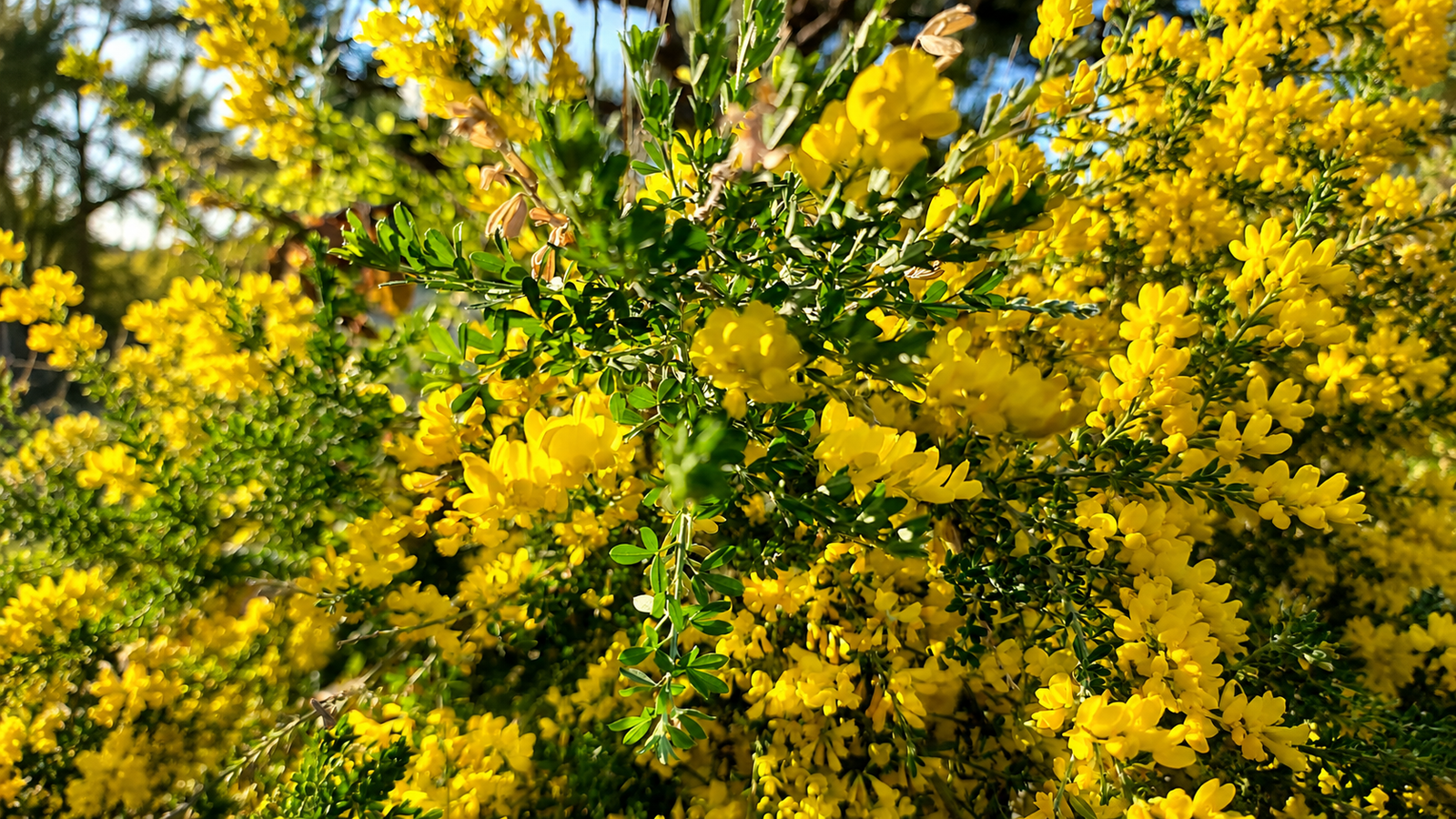
In the photograph, the Scotch broom sways in the wind. The flowers are vivid, yet the entire scene carries a slight blur of movement. That gentle instability captures the essence of spring remarkably well. Spring is never a still season. Leaves emerge, flowers open, sunlight deepens, and breezes move through the world. The brilliance of Scotch broom becomes even more radiant within that motion.
In Japanese, the plant is called エニシダ, and it is also known by the poetic name 金雀花, literally “golden sparrow flower.” The name beautifully captures both the shape and color of the blossoms. The tiny yellow petals gathered along the branches resemble sparrows resting in sunlight. In haiku, such flowers are not merely botanical objects; they become seasonal presences carrying the warmth of late spring, the density of light, and the overflowing vitality of nature.
Haiku values the capture of a fleeting moment rather than lengthy explanation. Thus, when writing about Scotch broom, it is more effective not to say “the flowers are beautiful,” but to reveal how the flowers transform the surrounding world. The important moment is not simply that yellow blossoms exist, but that the wind itself seems yellow because of them, or that the afternoon light appears brighter while passing beside them.
Scotch broom blossomswhen the wind passes throughsunlight trembles too
The essence of this haiku lies not in the flowers alone, but in the relationship between blossoms, wind, and sunlight. The flowers remain still, yet the passing wind makes their yellow shimmer, and through that movement even the sunlight seems to sway. This relational sensitivity is at the heart of haiku aesthetics.
Another approach may be written as:
Yellow flower hedgeeven the passing afternoonpauses for a while
Here, the flowers appear to hold time itself. Not only the observer stops, but even the afternoon seems to linger. A successful haiku does not merely describe scenery; it places the reader inside the moment. The “afternoon” here is both literal and emotional time — a slow, golden hour colored by blossoms.
In Korean haiku, Scotch broom may not yet be a widely established seasonal word. Yet precisely for that reason, it offers new possibilities. Korean haiku should not merely imitate the traditional Japanese seasonal vocabulary, but continue discovering seasonal expressions rooted in Korean landscapes and lived experience. If Scotch broom repeatedly appears in gardens, roadsides, and parks, then it naturally becomes part of Korea’s own seasonal imagination.
A seasonal word is not simply the name of a flower. It is a cultural memory of how people feel the seasons. For earlier generations, plum blossoms and chrysanthemums carried the spirit of the year. For us today, perhaps Scotch broom along a path, azaleas in apartment gardens, or white fringe blossoms in a city park may become new vessels of seasonal emotion.
The yellow blossoms in the photograph remind us that spring does not always pass quietly. Sometimes it arrives with dazzling brightness, coloring even the edges of the heart. Haiku is the small vessel that preserves such moments.
O Scotch broom flowerseven today’s passing windbreathes yellow light